
AI writing tools are no longer just simple text generators. The best platforms can now help with long-form content, SEO research, brand voice, rewriting, content optimization, and publishing workflows—but the right choice depends heavily on what you actually need to create.
For marketing teams, Jasper stands out for brand consistency and structured content workflows. Writesonic is a stronger fit for users focused on SEO and AI-search visibility, while Koala AI is particularly appealing to bloggers and affiliate publishers who want a faster path from keyword to publishable article.
If your priority is editing rather than content generation, tools such as Grammarly and QuillBot may be a better investment than a full AI writing platform.
To make the decision easier, we compared 10 of the best AI writing tools in 2026 based on writing capabilities, SEO features, ease of use, long-form workflows, pricing, and overall value.
Short on time? Start with the quick picks below to see which AI writer best matches your workflow before comparing all 10 tools in detail.
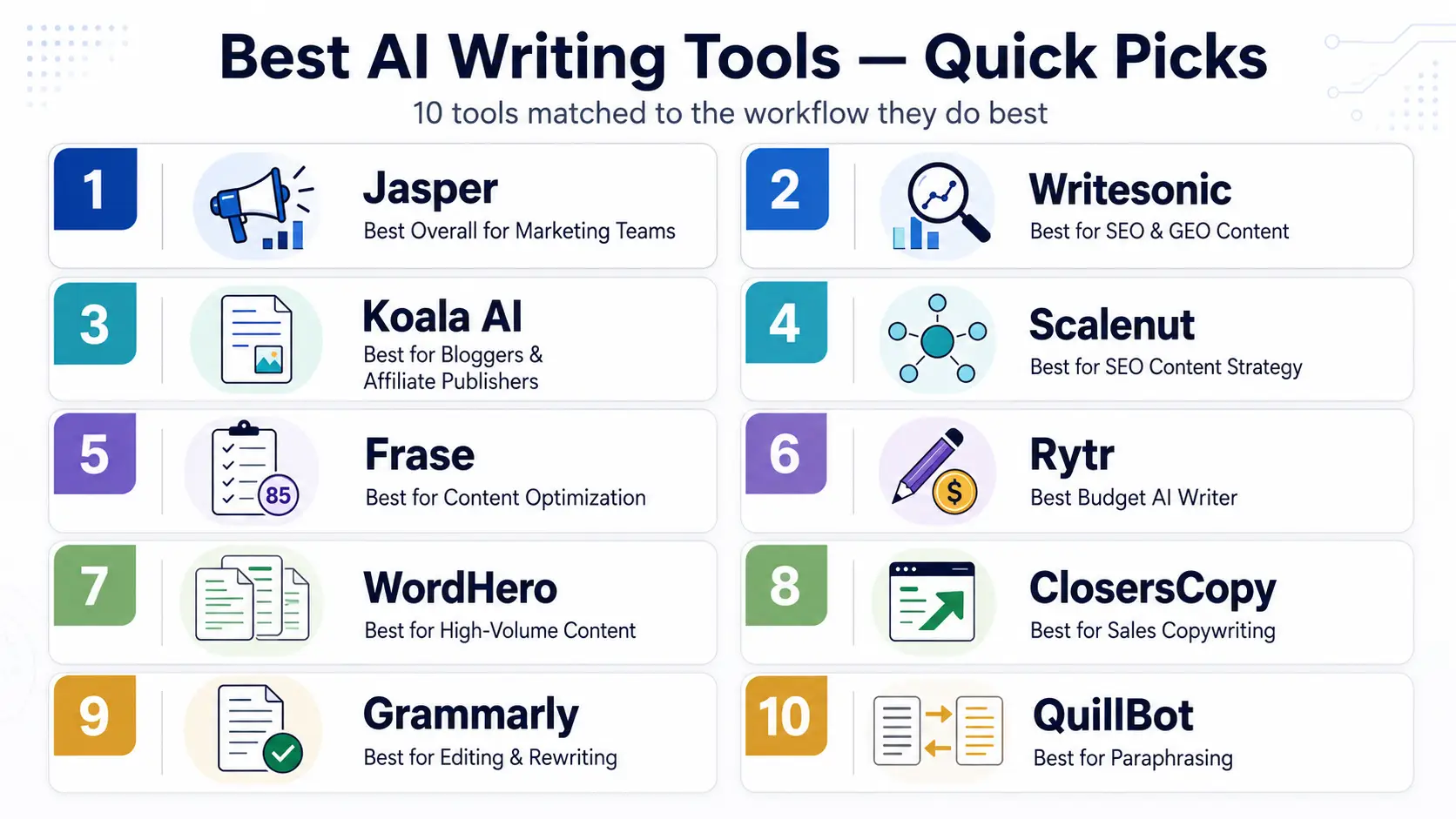
Best AI Writing Tools — Quick Picks
If you already know what kind of content you create most often, you can narrow the list down quickly.
| AI Writing Tool | Best For | Why It Stands Out |
|---|---|---|
| Jasper | Best Overall for Marketing Teams | Strong brand voice, campaign workflows, and team-focused content production |
| Writesonic | Best for SEO & GEO Content | Combines AI writing with SEO workflows and AI-search visibility |
| Koala AI | Best for Bloggers & Affiliate Publishers | Fast long-form publishing workflow with SEO and CMS-focused features |
| Scalenut | Best for SEO Content Strategy | Strong for topic planning, content clusters, optimization, and search-focused workflows |
| Frase | Best for Content Optimization | Excellent for SERP research, content briefs, and improving existing drafts |
| Rytr | Best Budget AI Writer | Simple, affordable, and easy to use for everyday writing tasks |
| WordHero | Best for High-Volume Content | Useful for creating multiple content formats at scale |
| ClosersCopy | Best for Sales Copywriting | Focused on persuasive copy, landing pages, ads, and conversion-oriented writing |
| Grammarly | Best for Editing & Rewriting | Strong for grammar, clarity, tone, and polishing existing content |
| QuillBot | Best for Paraphrasing | Purpose-built for rewriting, summarizing, and improving existing text |
Best AI Writing Tools Compared
The biggest differences between AI writing tools are not always obvious from their feature lists.
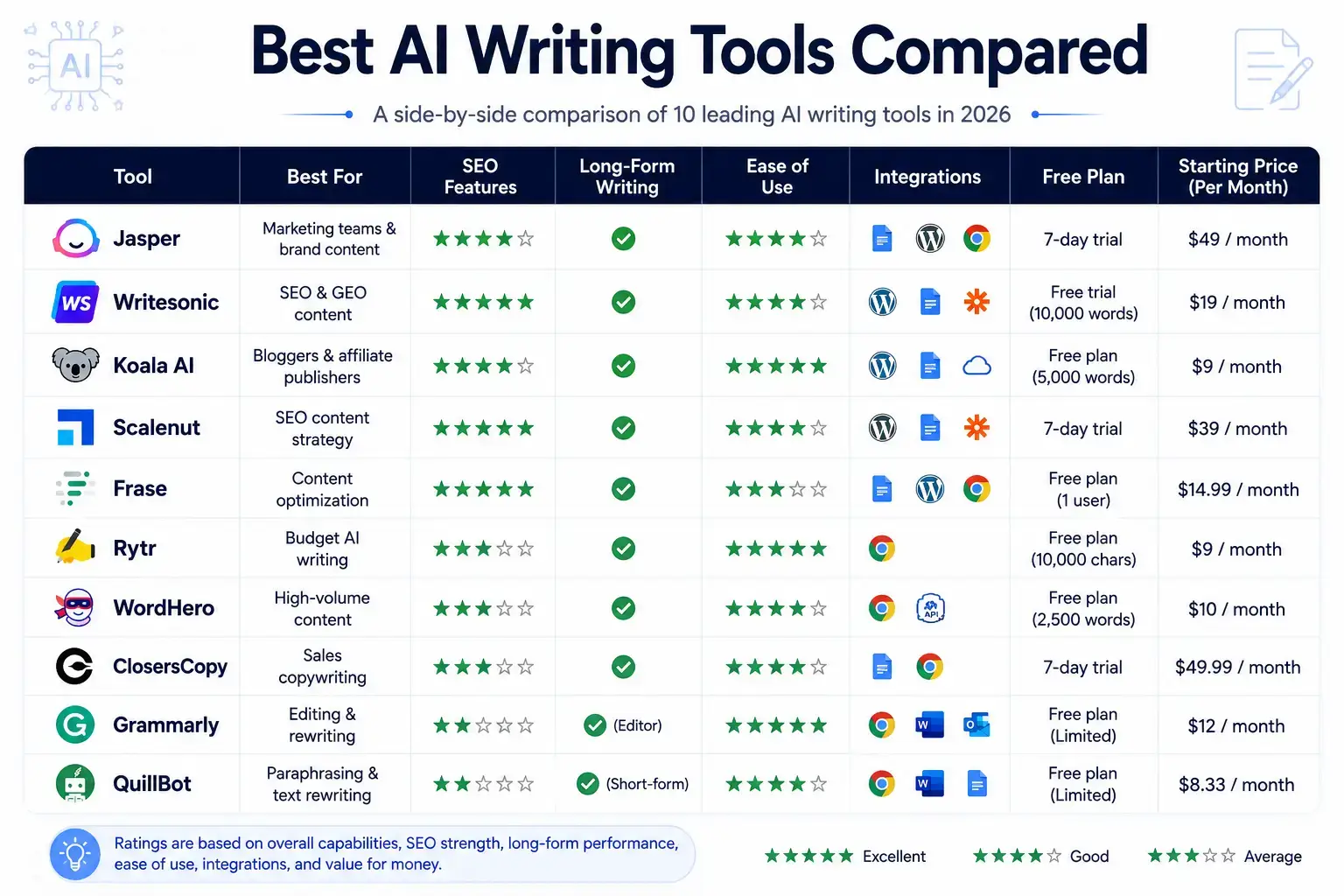
Some platforms are built for marketing teams, others for SEO publishers, while tools such as Grammarly and QuillBot are much better at improving existing writing than producing complete long-form articles from scratch.
Use the table below to compare the 10 tools at a glance before reading the individual recommendations.
| AI Writing Tool | Best For | Starting Price* | Free Plan / Trial | SEO | Long-Form Writing | Ease of Use |
|---|---|---|---|---|---|---|
| Jasper | Marketing teams | $59/mo annually | 7-day trial | Good | Strong | Easy–Moderate |
| Writesonic | SEO & GEO content | $79/mo annually | 7-day trial | Excellent | Excellent | Moderate |
| Koala AI | Bloggers & affiliate publishers | $9/mo | Limited free access | Strong | Excellent | Very Easy |
| Scalenut | SEO content strategy | $59/mo | 7-day trial | Excellent | Strong | Moderate |
| Frase | Content optimization | $39/mo annually | 7-day trial | Excellent | Strong | Easy–Moderate |
| Rytr | Budget users | Free / $7.50 paid | Free plan | Basic | Moderate | Very Easy |
| WordHero | High-volume content | $29/mo annually | No permanent free plan | Moderate | Strong | Easy |
| ClosersCopy | Sales copywriting | $49.99/mo | Money-back guarantee | Moderate | Strong | Moderate |
| Grammarly | Editing & rewriting | Free / $12 Pro annually | Free plan | Basic | Limited | Very Easy |
| QuillBot | Paraphrasing | Free / $8.33 Premium annually | Free plan | Basic | Limited–Moderate | Very Easy |
*Pricing can change. Always check the provider’s current pricing before subscribing.
Best Overall: Jasper
Choose Jasper if you need an AI writing platform that fits into a broader marketing workflow rather than simply generating articles.
Its biggest advantage is the ability to keep brand voice, audience context, and marketing messaging consistent across different types of content.
For solo bloggers, Jasper may be more expensive than necessary. For teams managing campaigns and multiple content formats, the added structure can justify the higher price.
Best fit: marketing teams, agencies, and brand-focused businesses.
Best for SEO & GEO: Writesonic
Choose Writesonic if search visibility is one of your primary reasons for investing in AI writing software.
Its combination of long-form article generation, SEO workflows, and tools aimed at tracking visibility in AI-powered search makes it one of the most search-focused platforms in this comparison.
It is more expensive than lightweight AI writers, but users may be able to replace parts of several separate SEO and content workflows.
Best fit: SEO teams, content marketers, agencies, and search-led publishers.
Best Value for Bloggers: Koala AI
For bloggers and affiliate publishers, Koala AI offers one of the strongest price-to-workflow combinations.
Its low starting price is paired with features built specifically around long-form publishing, including SEO-oriented article creation and CMS-focused workflows.
It lacks some of the broader marketing capabilities found in Jasper and the deeper GEO analytics found in Writesonic, but many publishers will not need those features.
Best fit: bloggers, niche-site owners, affiliate marketers, and high-volume publishers.
Best Budget Option: Rytr
If price is your main concern, Rytr is the easiest place to start.
Its free plan and low-cost paid tier make it suitable for users who want AI assistance without committing to a larger SEO or marketing platform.
The tradeoff is depth: advanced SEO teams and long-form publishers will likely outgrow it.
Best fit: freelancers, beginners, small businesses, and light users.
Quick takeaway: Jasper is the stronger marketing platform, Writesonic is the stronger search-focused option, Koala AI offers compelling value for publishers, and Rytr is the easiest low-cost entry point.
Next, we explain how these tools are evaluated so the rankings are based on more than feature count or affiliate commission.
How We Evaluated the Best AI Writing Tools
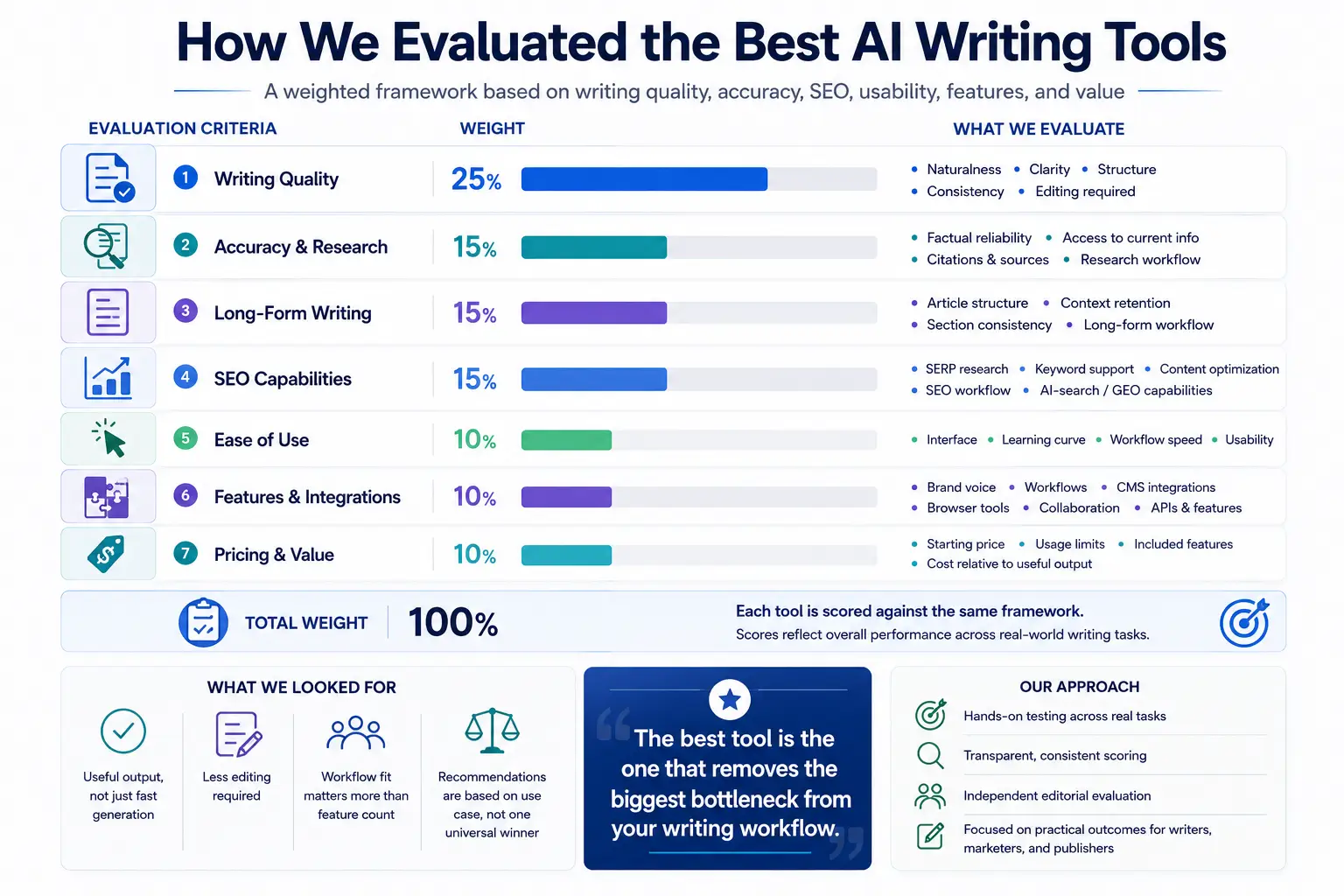
AI writing tools can look surprisingly similar on a pricing page. Most promise faster content creation, better writing, and dozens of AI-powered features.
The real differences appear when you look at how much useful work each tool removes from your workflow.
For this guide, we evaluated the tools across seven areas that matter most to writers, marketers, bloggers, and SEO teams.
What We Looked For
Writing quality carries the most weight. A tool can generate thousands of words quickly, but that speed means very little if the output is repetitive, generic, or requires heavy editing.
We also considered whether each platform can support factual research, maintain context in longer articles, and adapt to different tones or audiences.
For SEO-focused tools, we looked beyond basic keyword insertion. More advanced capabilities such as SERP research, content optimization, internal linking, topic planning, and GEO features can make a meaningful difference for publishers using AI as part of a larger search workflow.
Ease of use matters too. A powerful platform should not create more friction than it removes. We therefore considered how quickly a new user can move from setup to a usable draft.
Finally, we compared pricing against what the tool actually replaces.
A $60-per-month platform may offer better value than a $10 writer if it combines several workflows such as:
-
AI writing
-
SEO research
-
content optimization
-
brand voice
-
publishing
-
team collaboration
How to Read Our Recommendations
The highest-scoring tool is not automatically the best AI writer for every user.
A marketing team may get more value from Jasper because of its brand and workflow features, while a solo blogger may prefer Koala AI because it provides a much more direct path from keyword to publishable article.
Similarly, Grammarly may score lower for long-form generation but still be the better choice for someone whose main goal is editing and rewriting.
That is why every recommendation in this guide is tied to a specific “Best For” use case.
Instead of asking:
Which AI writing tool has the most features?
A better question is:
Which tool solves the biggest bottleneck in my current writing workflow?
With that framework in mind, let’s look at the individual tools—starting with our top pick for marketing teams.
1. Jasper – Best Overall for Marketing Teams
Jasper is our top pick for marketing teams that need consistent, on-brand content across multiple channels. Rather than positioning itself as a basic AI writer, Jasper now focuses on marketing workflows, specialized AI agents, reusable brand context, and content production at scale. Its platform supports brand voice, audience profiles, company knowledge, campaign execution, SEO/GEO workflows, and multi-channel content creation.
Quick Facts
-
Best For: Marketing teams, agencies, and brand-focused businesses
-
Starting Price: $59/month per seat when billed annually
-
Free Trial: 7 days
-
Best Feature: Brand Voice + reusable marketing context
-
Ease of Use: Easy to moderate
Why We Picked Jasper
Jasper stands out because it helps teams avoid one of the biggest problems with AI-generated marketing content: inconsistent brand voice.
Its Brand Voice feature can learn from existing text, documents, and URLs, while Jasper IQ applies brand, audience, and company context across content workflows. Jasper also offers purpose-built marketing agents for tasks such as SEO, email, social, campaigns, personalization, and content optimization.
That makes Jasper especially useful when AI writing is part of a broader marketing operation—not just a way to generate occasional blog posts.
Jasper Pros & Cons
Pros
-
Strong Brand Voice and brand consistency
-
Built specifically around marketing workflows
-
Useful for teams producing content across multiple channels
Cons
-
More expensive than lightweight AI writers
-
May be overkill for solo bloggers who mainly need long-form SEO articles
Jasper Verdict
Choose Jasper if your priority is scaling marketing content without losing control of your brand voice. If your workflow is primarily SEO blogging, a more specialized option such as Writesonic or Koala AI may offer better value.
2. Writesonic – Best for SEO & GEO Content
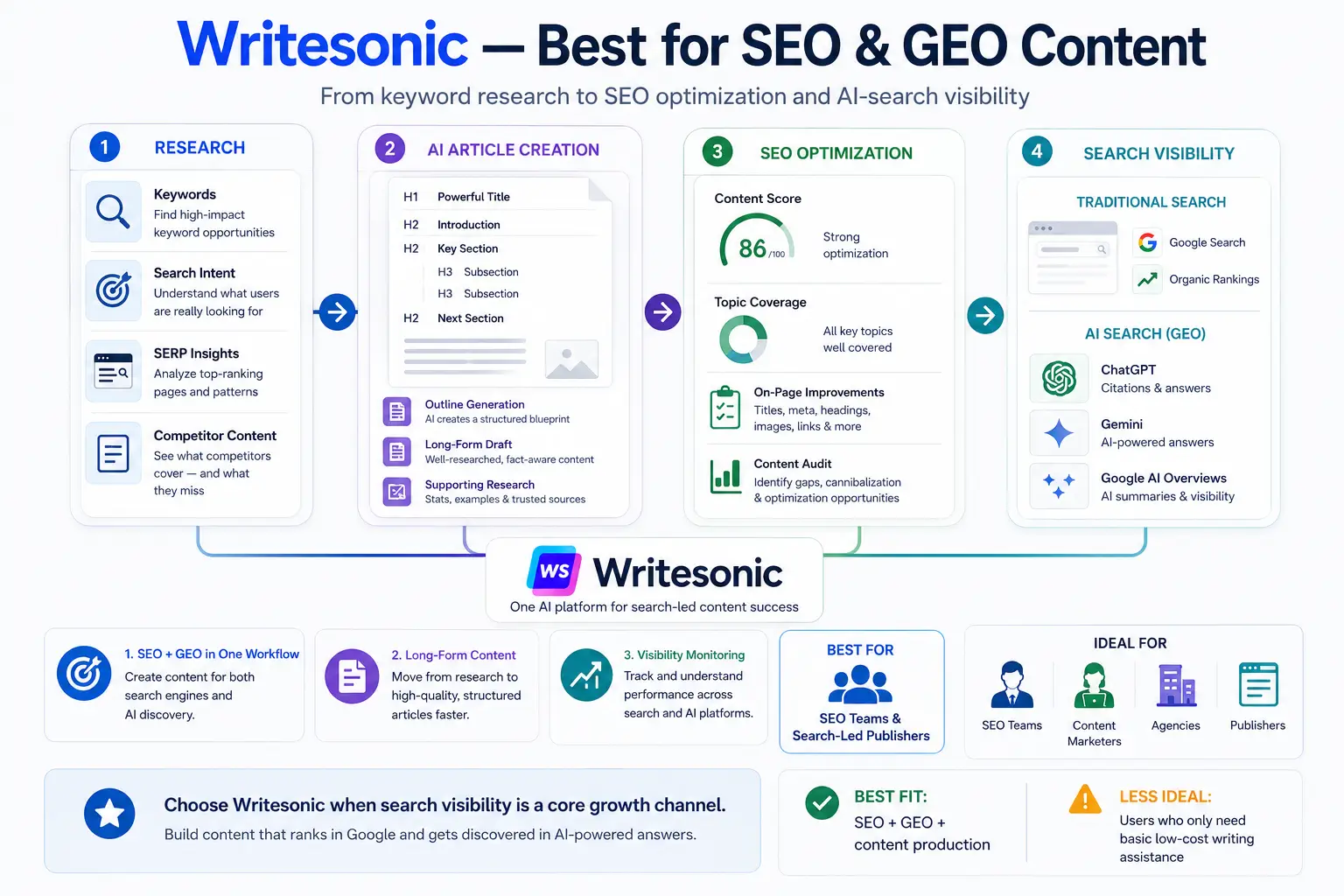
Writesonic is our top pick for users who want AI writing tied directly to SEO and AI-search visibility. Unlike basic AI writers that stop after generating a draft, Writesonic combines long-form article creation with content strategy, site auditing, and tracking across platforms such as ChatGPT, Gemini, and Google AI Overviews.
Quick Facts
-
Best For: SEO teams, agencies, and search-led publishers
-
Starting Price: $79/month billed annually
-
Free Trial: Available
-
AI Articles: 15/month on Starter
-
Best Feature: SEO + GEO workflow in one platform
Why We Picked Writesonic
Writesonic stands out because it connects content creation with search performance.
Its current platform includes an AI Article Writer, content strategy tools, SEO-focused workflows, site audits, and AI visibility tracking. The Starter plan currently tracks brand visibility across ChatGPT, Gemini, and Google AI Overviews, while higher tiers expand article limits, tracking capacity, and workflow automation.
That makes it especially attractive if your goal is not simply to write faster, but to create content that supports both traditional SEO and emerging AI-search discovery.
Writesonic Pros & Cons
Pros
-
Strong SEO and long-form content workflow
-
Built-in AI-search visibility tracking
-
Combines writing, auditing, and search strategy
Cons
-
More expensive than lightweight AI writers
-
Broader feature set may feel excessive for casual users
Writesonic Verdict
Choose Writesonic if SEO and GEO are central to your content strategy. If you mainly need inexpensive blog generation without advanced visibility tracking, Koala AI may offer a simpler and lower-cost workflow.
Read Our Full Writesonic Review | Try Writesonic Free
3. Koala AI – Best for Bloggers & Affiliate Publishers
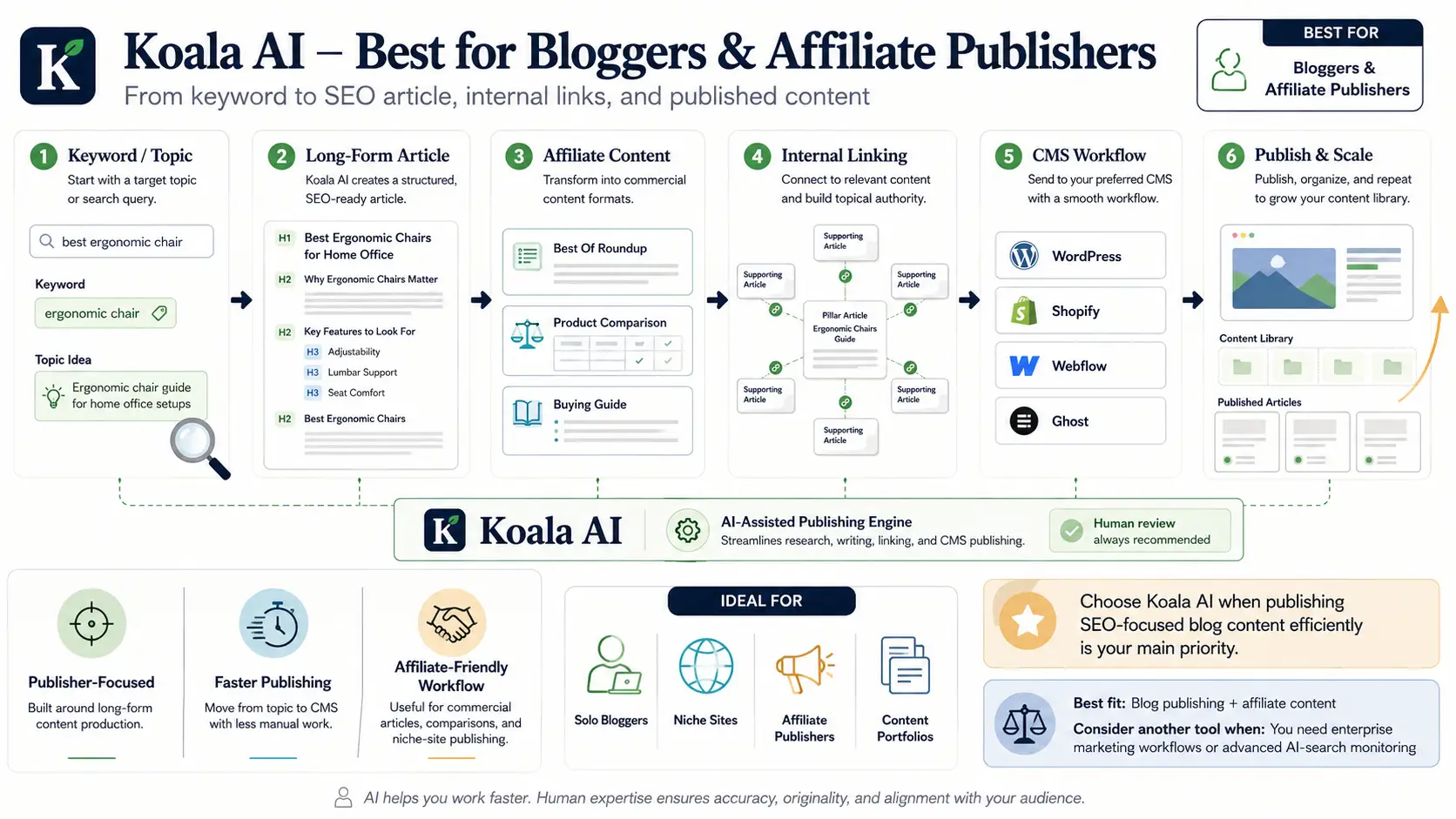
Koala AI is one of the most focused options in this list for bloggers, niche-site owners, and affiliate publishers. Its main strength is not enterprise marketing automation—it is helping users move quickly from a target keyword to an SEO-focused long-form article and then into a publishing workflow. Koala combines KoalaWriter with tools for real-time data, internal linking, images, and CMS publishing.
Quick Facts
-
Best For: Bloggers, affiliate publishers, and SEO content sites
-
Starting Price: $9/month
-
Free Access: 5,000 writing words + 25 chat messages
-
Entry Plan: 15,000 KoalaWriter words/month
-
Best Feature: Keyword-to-published-article workflow
Why We Picked Koala AI
Koala stands out because its feature set closely matches how content publishers actually work.
KoalaWriter supports SEO optimization, real-time web data, editable outlines, bulk content creation, and direct integrations with platforms such as WordPress, Shopify, Webflow, and Ghost. Its ecosystem also includes automated internal linking through KoalaLinks.
Affiliate publishers get an additional advantage: Koala supports Amazon product-roundup workflows using live product data and can automatically apply an Amazon affiliate tracking ID to product links.
Koala AI Pros & Cons
Pros
-
Strong workflow for SEO-focused long-form content
-
Direct CMS publishing and internal-linking tools
-
Very low starting price compared with larger SEO platforms
Cons
-
Less suited to complex enterprise marketing workflows
-
High-volume AI publishing still requires strong human fact-checking and editorial QA
Koala AI Verdict
Choose Koala AI if your priority is producing blog or affiliate content efficiently without paying for a larger marketing platform. If you need deeper team workflows or enterprise brand controls, Jasper is the stronger fit.
Read Our Full KoalaWriter Review | Try Koala AI Free
4. Scalenut — Best for SEO Content Strategy
Scalenut is a strong choice for teams that need more than an AI article generator. It combines keyword planning, topical clustering, long-form writing, content optimization, internal linking, and AI-search visibility in one SEO-focused workflow. Its current platform is increasingly built around GEO as well as traditional search, making it particularly relevant for publishers planning entire content clusters rather than individual articles.
Quick Facts
-
Best For: SEO teams, agencies, and content strategists
-
Starting Price: $59/month
-
Free Trial: 7 days
-
GEO Articles: 5/month on Starter
-
Best Feature: Keyword-to-content-cluster workflow
Why We Picked Scalenut
Scalenut stands out for connecting content strategy with content execution.
Its Keyword Planner groups related queries into topical clusters and surfaces intent, keyword gaps, search-volume signals, and AI-oriented prompts. Cruise Mode then turns a selected topic into a structured long-form draft using SERP data, competing outlines, semantic terms, and GEO-focused optimization.
That makes Scalenut especially useful when your workflow starts before the writing stage:
topic research → keyword cluster → article → optimization → internal links → content refresh
rather than simply:
prompt → article.
Scalenut Pros & Cons
Pros
-
Strong keyword and topical-cluster planning
-
Combines SEO writing with content optimization
-
Includes GEO and AI-visibility capabilities
Cons
-
More complex than lightweight AI writers
-
Many features are unnecessary if you only publish occasionally
Scalenut Verdict
Choose Scalenut if you are building a broader SEO content strategy and want planning, writing, optimization, and GEO tools connected in one platform.
If you mainly want fast blog drafts, Koala AI is simpler. If AI-search monitoring is your primary concern, Writesonic is also worth comparing closely.
Read Our Full Scalenut Review | Try Scalenut Free for 7 Days →
5. Frase — Best for Content Optimization
Frase is a strong fit for writers and SEO teams that care more about researching, structuring, and improving content than simply generating large volumes of text. Its workflow combines SERP research, content briefs, AI-assisted drafting, live SEO/GEO scoring, and content refresh recommendations in one workspace.
Quick Facts
-
Best For: SEO writers, editors, agencies, and content teams
-
Starting Price: $39/month when billed annually
-
Free Trial: 7 days, no credit card required
-
Best Feature: SERP research + live content optimization
-
SEO/GEO: Built-in scoring for both traditional search and AI discovery
Why We Picked Frase
Frase stands out because it helps answer a question every SEO writer faces before publishing:
What is this draft still missing?
The platform analyzes pages already ranking for a target query, surfaces their topics, headings, questions, and content gaps, then turns that research into a structured brief. While you write, Frase provides a live optimization score and identifies specific areas that may need stronger coverage.
It can also import an existing URL and compare the page against the current SERP, making Frase particularly useful for refreshing older content, not just producing new articles.
Frase Pros & Cons
Pros
-
Excellent SERP research and content-brief workflow
-
Live SEO and GEO optimization while editing
-
Useful for identifying gaps in existing content
Cons
-
Less focused on high-volume one-click article generation
-
Optimization scores still require editorial judgment rather than being treated as a ranking formula
Frase Verdict
Choose Frase if your biggest challenge is turning research into a better brief and improving drafts before—or after—they are published.
If your priority is producing large numbers of articles quickly, Koala AI may be a more direct fit. If you want broader SEO planning and topical clustering, Scalenut is worth comparing alongside it.
Read Our Full Frase Review | Try Frase Free for 7 Days
6. Rytr – Best Budget AI Writer
Rytr is one of the easiest AI writing tools to recommend to beginners, freelancers, and small businesses that want useful writing assistance without paying for a larger SEO or marketing platform. Its appeal is simple: low pricing, a permanent free plan, unlimited generation on the paid Unlimited tier, and a straightforward interface focused on everyday writing tasks.
Quick Facts
-
Best For: Beginners, freelancers, and budget-conscious users
-
Starting Price: Free
-
Unlimited Plan: $7.50/month on annual billing
-
Free Plan: 10,000 characters/month
-
Best Feature: Low-cost unlimited AI generation on the paid plan
Why We Picked Rytr
Rytr stands out because it keeps the learning curve and cost low.
The free plan includes 10,000 characters per month, while the Unlimited tier removes the monthly generation cap and adds a personalized tone of voice plus plagiarism checks. Rytr also supports more than 40 writing use cases, including emails, SEO meta titles, calls to action, paragraphs, replies, and social content.
That makes Rytr a practical option if you need help producing short-form and everyday business content, but do not need the deeper SEO, research, or publishing workflows offered by tools such as Writesonic or Scalenut.
Rytr Pros & Cons
Pros
-
Permanent free plan with no credit card required
-
Very affordable paid plan with unlimited generation
-
Simple interface and broad range of everyday writing use cases
Cons
-
Limited advanced SEO and content-strategy features
-
Less suitable for complex, research-heavy long-form publishing
Rytr Verdict
Choose Rytr if affordability and simplicity matter more than advanced SEO or enterprise workflows. It is especially attractive for freelancers and small businesses that want a low-risk way to add AI to everyday writing.
If your main goal is publishing search-driven long-form content at scale, Koala AI, Writesonic, or Scalenut will offer more specialized workflows.
Read Our Full Rytr Review | Try Rytr Free
7. WordHero – Best for High-Volume Content
WordHero is a good fit for creators who need to produce a large variety of content without constantly worrying about word limits. Its Creator plan includes unlimited standard-mode generation, a long-form editor, SEO tools, Brand Voices, image generation, and support for 108 languages, making it a flexible option for bloggers, freelancers, and small teams producing content at scale.
Quick Facts
-
Best For: Content creators, freelancers, and small teams
-
Starting Price: $29/month billed annually
-
Monthly Price: $49/month
-
Free Plan: No permanent free plan publicly listed
-
Best Feature: Unlimited standard-mode content generation
Why We Picked WordHero
WordHero stands out for combining high-volume generation with a broader writing toolkit.
Its current Creator plan includes unlimited GPT-4o-mini content generation, 20 Brand Voices, a Long-Form Editor with Keyword Assistant, SEO Planner access, 320 monthly keyword credits, WordHero Chat, image-generation credits, and its Advanced Writer for one-click long-form content.
That makes it especially attractive for users who regularly switch between blog posts, marketing copy, emails, social content, and other formats but do not need the deeper SEO infrastructure of Writesonic or Scalenut.
WordHero Pros & Cons
Pros
-
Unlimited standard-mode content generation
-
Supports long-form writing, SEO planning, and Brand Voices
-
Supports 108 languages, which is useful for multilingual content teams
Cons
-
Advanced AI usage still has plan-based limits
-
SEO capabilities are lighter than dedicated platforms such as Writesonic, Scalenut, or Frase
WordHero Verdict
Choose WordHero if you produce a high volume of different content formats and want predictable usage without paying for a full enterprise SEO platform.
If your main goal is sophisticated SEO research or GEO tracking, another tool in this list will likely offer a stronger workflow.
Read Our Full WordHero Review | Try WordHero
8. ClosersCopy – Best for Sales Copywriting
ClosersCopy is the most specialized option in this list for sales copy, landing pages, ads, and conversion-focused writing. Instead of trying to be a general AI assistant for every type of content, it centers its workflow around long-form copywriting, reusable frameworks, SEO tools, and structured marketing workflows. Its current plans include Longform, SEO Planner, SEO Audit, Workflows, Insights, and a library of more than 700 copywriting frameworks.
Quick Facts
-
Best For: Copywriters, sales teams, and direct-response marketers
-
Starting Price: $49.99/month
-
Annual Billing: Available with a lower effective monthly cost
-
Free Trial: No traditional free plan; 14-day money-back guarantee
-
Best Feature: Large library of conversion-focused copywriting frameworks.
Why We Picked ClosersCopy
ClosersCopy stands out because it is built around persuasive writing rather than generic content generation.
Its framework library and workflow tools are designed for tasks such as sales pages, promotional emails, advertisements, and other conversion-oriented copy. The current Power plan includes 300 AI runs and 50 SEO audits each month, while higher Superpower tiers offer unlimited AI writing and SEO audits.
That makes it more relevant to a copywriter trying to improve conversions than to a publisher whose main goal is producing SEO blog posts as quickly as possible.
ClosersCopy Pros & Cons
Pros
-
Strong focus on sales and conversion copy
-
700+ copywriting frameworks and reusable workflows
-
Includes long-form writing and SEO planning tools
Cons
-
Less intuitive for users who only need simple blog writing
-
Starting price is relatively high compared with lightweight AI writers
ClosersCopy Verdict
Choose ClosersCopy if your content is expected to sell—especially landing pages, promotional emails, advertisements, and direct-response campaigns.
If your priority is SEO blogging or general content production, Koala AI, Writesonic, or Rytr will usually provide a more natural workflow.
Read Our Full ClosersCopy Review | Try ClosersCopy
9. Grammarly – Best for Editing & Rewriting
Grammarly is the strongest option in this list for users who already have a draft and want to make it clearer, more polished, and more consistent in tone. Unlike Jasper or Koala AI, Grammarly is primarily an AI-powered writing assistant and editor rather than a dedicated long-form content generator. Its current feature set includes proofreading, paragraph rewrites, tone adjustments, paraphrasing, AI-assisted drafting, and personalized writing suggestions.
Quick Facts
-
Best For: Editing, rewriting, proofreading, and tone improvement
-
Starting Price: Free
-
Grammarly Pro: $12/month per member when billed annually
-
Free Plan: Includes core writing assistance and 100 AI prompts
-
Best Feature: Real-time editing and rewriting across everyday writing workflows
Why We Picked Grammarly
Grammarly stands out because it works especially well as the final editing layer in a content workflow.
Its tools can catch grammar and punctuation issues, improve clarity, rewrite full sentences or paragraphs, adjust tone, and help users make writing sound more appropriate for a specific audience. Grammarly Pro currently also includes 2,000 generative AI prompts per month and brand-tone controls.
That makes Grammarly useful whether the first draft was written manually or generated with another AI tool.
Grammarly Pros & Cons
Pros
-
Excellent grammar, clarity, and tone assistance
-
Works well for editing existing AI-generated drafts
-
Generous permanent free plan
Cons
-
Not designed primarily for one-click long-form SEO articles
-
Advanced rewriting and AI features require Pro
Grammarly Verdict
Choose Grammarly if your biggest problem is not creating more words, but making existing writing clearer, more natural, and publication-ready.
If you need end-to-end SEO article generation, Writesonic or Koala AI will be a better fit.
Read Our Full Grammarly Review →
Try Grammarly Free →
10. QuillBot – Best for Paraphrasing
QuillBot is the strongest fit in this list for users who mainly need to rewrite, paraphrase, summarize, or improve existing text. Rather than competing directly with full long-form platforms such as Writesonic or Koala AI, QuillBot focuses on transforming drafts you already have through its Paraphraser, Grammar Checker, Summarizer, AI Humanizer, AI Detector, and related writing tools.
Quick Facts
-
Best For: Paraphrasing, rewriting, summarizing, and editing
-
Starting Price: Free
-
Premium: $8.33/month when billed annually
-
Free Plan: Paraphrase up to 125 words at a time, basic grammar correction, summaries, and limited AI Humanizer access
-
Best Feature: Unlimited paraphrasing with multiple rewriting modes on Premium
Why We Picked QuillBot
QuillBot stands out because its core workflow is extremely focused: take existing writing and make it better suited to your purpose.
The free version includes Standard and Fluency paraphrasing modes, while Premium unlocks unlimited paraphrasing, additional rewriting modes, advanced grammar recommendations, custom summaries, expanded AI Humanizer access, and plagiarism-related tools.
That makes QuillBot particularly useful for writers who regularly need alternative phrasings, shorter versions, clearer sentences, or rewritten drafts without paying for a full SEO content platform.
QuillBot Pros & Cons
Pros
-
Excellent dedicated paraphrasing workflow
-
Useful free plan for occasional rewriting
-
Premium combines paraphrasing, grammar, summarization, and humanization tools
Cons
-
Not designed as a complete long-form SEO publishing platform
-
Free paraphrasing limits are restrictive for larger documents
QuillBot Verdict
Choose QuillBot if rewriting existing content is more important to you than generating complete articles from scratch.
If you mainly want grammar and tone assistance across your everyday writing, Grammarly may be the better fit. If your goal is end-to-end SEO content production, Writesonic, Koala AI, or Scalenut will provide a more complete workflow.
Read Our Full QuillBot Review | Try QuillBot Free
Which AI Writing Tool Is Best for You?
The easiest way to choose an AI writing tool is to start with the task you need to complete most often.
A marketing team managing multiple campaigns has very different requirements from a solo blogger publishing SEO articles. Likewise, someone who mainly needs help rewriting existing drafts should not pay for a full content-production platform.
Use the table below as a quick decision guide.
| If You Need… | Best Choice | Why |
|---|---|---|
| Marketing workflows | Jasper | Strong Brand Voice, reusable company context, and multi-channel marketing workflows |
| SEO & GEO content | Writesonic | Combines AI article creation with SEO and AI-search visibility tools |
| Blogging & affiliate publishing | Koala AI | Streamlined long-form workflow with SEO and CMS publishing features |
| SEO content strategy | Scalenut | Strong keyword planning, topic clustering, optimization, and GEO capabilities |
| Content optimization | Frase | Excellent for SERP research, briefs, content scoring, and refreshing existing pages |
| Low-cost AI writing | Rytr | Affordable, easy to use, and suitable for everyday writing tasks |
| High-volume content | WordHero | Flexible writing toolkit with broad content-format support |
| Sales copy | ClosersCopy | Built around persuasive frameworks, landing pages, and conversion-focused content |
| Editing & rewriting | Grammarly | Strong grammar, clarity, tone, and rewrite assistance |
| Paraphrasing | QuillBot | Purpose-built for rewriting, paraphrasing, summarizing, and improving existing text |
Choose Jasper If Marketing Is Your Main Workflow
If you regularly create campaigns, landing pages, emails, ads, and branded content, Jasper is the strongest fit in this list.
Its value becomes clearer when multiple people need to create content while maintaining a consistent brand voice.
For a solo blogger, however, you may end up paying for marketing features you rarely use.
Choose Writesonic If Search Visibility Matters Most
Writesonic is the better choice when your content strategy is heavily dependent on SEO and emerging AI-search visibility.
It is particularly appealing to teams that want content generation, search optimization, and GEO-related workflows inside the same platform.
If search is the primary acquisition channel for your business, the extra cost may be easier to justify.
Choose Koala AI If You Publish Blogs at Scale
Koala AI is one of the easiest recommendations for bloggers, niche-site owners, and affiliate publishers.
Its workflow is built around getting from a keyword or topic to a long-form draft efficiently, while reducing friction around SEO optimization and publishing.
If most of your content is blog-based, Koala may offer better value than paying for a broader marketing platform.
Choose Scalenut If Strategy Comes Before Writing
Scalenut is a better fit when your challenge is not simply creating articles, but deciding what content to create next.
Its keyword planning, topic clustering, optimization, and content-strategy features make it useful for teams building larger topical-authority programs.
Choose Frase If You Already Have Content to Improve
Frase is particularly useful for writers and editors who want to understand:
What are competing pages covering that ours is missing?
Its SERP research and optimization workflow make it a strong choice for both new articles and existing pages that need to be refreshed.
Choose Rytr If Budget Is the Priority
Rytr makes the most sense if you want useful AI writing assistance without committing to a larger subscription.
It is particularly suitable for freelancers, beginners, and small businesses producing shorter or less complex content.
You will give up some advanced SEO and workflow capabilities, but you may not need them.
Choose WordHero If You Need More Content Formats
WordHero is worth considering if your workload includes a mix of:
-
blog content;
-
emails;
-
social posts;
-
marketing copy;
-
product descriptions;
-
multilingual content.
Its value comes from flexibility and content volume rather than deep specialization in one SEO or marketing workflow.
Choose ClosersCopy If the Goal Is Conversion
If your content needs to persuade readers to act, ClosersCopy is the most specialized option here.
It is best suited to users creating sales pages, promotional emails, ads, landing pages, and direct-response copy.
For general SEO blogging, other tools in this guide are easier to recommend.
Choose Grammarly If You Already Write the First Draft
Grammarly is ideal when you do not need AI to create an entire article for you.
Instead, you need help making an existing draft:
-
clearer;
-
grammatically correct;
-
more concise;
-
more consistent in tone;
-
easier to read.
It can also complement another AI writer rather than replace it.
Choose QuillBot If Rewriting Is the Main Job
QuillBot is the better choice if your workflow revolves around existing text.
It is especially useful when you need to:
-
paraphrase;
-
shorten;
-
summarize;
-
rewrite;
-
create alternative versions of a passage.
For full article production, however, it is less complete than dedicated long-form writing platforms.
The Simplest Way to Decide
If you are still unsure, reduce the decision to one question:
What part of my writing workflow currently takes the most time?
If the answer is:
-
marketing execution → Jasper
-
SEO and GEO → Writesonic
-
blog publishing → Koala AI
-
content planning → Scalenut
-
optimization → Frase
-
basic writing on a budget → Rytr
-
high-volume content creation → WordHero
-
sales copy → ClosersCopy
-
editing → Grammarly
-
rewriting → QuillBot
The best AI writing tool is not the platform with the longest feature list. It is the one that removes the biggest bottleneck from your existing workflow.
Next, we narrow the recommendations even further by looking at the best AI writing tools for specific use cases, including blogging, SEO, affiliate marketing, small business, editing, and copywriting.
How to Choose the Best AI Writing Tool
The best AI writing tool is not necessarily the one with the most features. It is the one that matches your content type, workflow, publishing volume, and budget.
Before subscribing, start by identifying the part of your writing process that takes the most time.
Start With Your Primary Use Case
Different tools are optimized for different jobs.
If your priority is:
-
Marketing campaigns → Jasper
-
SEO & GEO content → Writesonic
-
Blog publishing → Koala AI
-
SEO planning → Scalenut
-
Content optimization → Frase
-
Budget writing assistance → Rytr
-
Sales copy → ClosersCopy
-
Editing → Grammarly
-
Paraphrasing → QuillBot
This is a better starting point than comparing feature counts.
A tool with 100 features may provide less value than a simpler platform that solves the one problem slowing you down every day.
Compare Writing Quality
AI-generated content should require less work—not create another editing problem.
When testing a writing tool, look at:
-
how natural the output sounds;
-
whether ideas flow logically;
-
repetition;
-
sentence variety;
-
tone consistency;
-
how closely the tool follows instructions;
-
how much editing is required before publication.
A useful test is to give several tools the same prompt and compare the results side by side.
Do not judge only the first paragraph.
For long-form content, check whether the quality remains consistent across the entire article.
Consider Long-Form Capabilities
Not every AI writer that can generate 2,000 words is good at long-form writing.
Bloggers and publishers should pay attention to whether a tool can handle:
-
structured outlines;
-
H2 and H3 hierarchy;
-
context across multiple sections;
-
content expansion;
-
section-level rewriting;
-
research;
-
citations;
-
internal links;
-
publishing integrations.
For example, a tool may be excellent at emails and social posts but become repetitive when generating a detailed article.
If long-form content drives most of your traffic, this should be one of your highest-priority evaluation criteria.
Look at SEO Features
If organic traffic matters to your business, compare the SEO workflow—not just whether the platform has an “SEO mode.”
Useful SEO features may include:
-
keyword research;
-
search intent analysis;
-
SERP research;
-
competitor analysis;
-
NLP or semantic recommendations;
-
content briefs;
-
optimization scores;
-
internal linking;
-
content audits;
-
topical clustering;
-
GEO or AI-search visibility.
Platforms such as Writesonic, Scalenut, and Frase put considerably more emphasis on this part of the workflow than lightweight AI writing assistants.
However, an optimization score should never become the goal itself.
The objective is still to create the most useful page for the reader.
Check Brand Voice and Customization
Brand Voice matters much more for teams than it does for occasional writers.
If several people are producing content for the same company, look for features that can preserve:
-
tone;
-
terminology;
-
audience positioning;
-
product information;
-
company knowledge;
-
messaging rules.
Without this layer, teams often spend significant time rewriting AI-generated drafts simply to make them sound like the same brand.
For agencies and marketing departments, persistent brand context can therefore be more valuable than raw generation speed.
Evaluate Research and Accuracy
AI-generated writing can sound convincing even when the underlying information is wrong.
If your content includes:
-
statistics;
-
software pricing;
-
product features;
-
research findings;
-
legal or financial information;
-
current events;
-
product recommendations,
research and verification should be part of your workflow.
Look for tools that can work with current sources, URLs, documents, or citations.
But even when a platform provides sources, human fact-checking is still necessary.
The best AI writing workflow is not:
Generate → Publish
It is:
Research → Generate → Verify → Edit → Publish
Check Integrations
A writing tool becomes more valuable when it connects with software you already use.
Common integrations worth checking include:
-
WordPress
-
Shopify
-
Webflow
-
Google Docs
-
Notion
-
Contentful
-
Zapier
-
browser extensions
-
APIs
For an occasional writer, integrations may not matter much.
For a publisher creating 50 articles every month, removing repetitive copying, formatting, and uploading can save significant time.
Compare Pricing Against Actual Usage
Do not choose an AI writer based only on the lowest monthly price.
Instead, compare:
Cost ÷ Useful Output
A $10 tool is not a bargain if every article requires an hour of rewriting.
Likewise, a $70 platform may be good value if it replaces several separate tools and saves multiple hours every week.
Before subscribing, estimate:
-
how many pieces of content you produce;
-
which features you will actually use;
-
whether there are word or article limits;
-
whether premium AI models consume additional credits;
-
how many team seats you need;
-
which other subscriptions the tool could replace.
A Simple Buying Rule
If you are still unsure, use this decision sequence:
What do I create most often?
        ↓
What part of that workflow takes the most time?
        ↓
Which tool specializes in removing that bottleneck?
        ↓
Does the time saved justify the subscription?
        ↓
Test it before committing long term
The goal is not to find the “most powerful” AI writer.
It is to find the tool that helps you produce better content with less unnecessary work.
Next, we address one of the biggest questions buyers now have: Do you actually need a dedicated AI writing tool when ChatGPT, Claude, and Gemini can already generate content?
Frequently Asked Questions About AI Writing Tools
What Is the Best AI Writing Tool Overall?
There is no single best AI writing tool for every workflow. For this guide, Jasper is our best overall choice for marketing teams because it combines AI writing with brand voice, reusable company context, and structured marketing workflows.
However, Writesonic is a better fit for SEO-focused teams, while Koala AI makes more sense for bloggers and affiliate publishers.
The best choice depends on the bottleneck you are trying to remove—not the number of features a platform offers.
What Is the Best AI Writer for SEO?
Writesonic is our top AI writer for SEO, particularly for users who also care about visibility across AI-powered search environments.
It combines long-form article creation with SEO-oriented workflows, making it a stronger fit for search-led content teams than general-purpose writing assistants.
Scalenut is our closest alternative if keyword planning, topic clusters, and broader content strategy are more important to you than AI-search visibility.
For pure content optimization rather than end-to-end creation, Frase is also worth considering.
What Is the Best AI Writing Tool for Bloggers?
For bloggers, we recommend Koala AI.
Its workflow is closely aligned with how content publishers work: start with a keyword or topic, create a structured long-form draft, optimize the content, add internal links, and move it toward a CMS.
Its lower entry cost also makes it easier to justify for solo bloggers and niche-site owners than larger marketing platforms.
If your blogging operation requires deeper SEO analytics and GEO capabilities, Writesonic may be the better upgrade.
What Is the Best Free AI Writing Tool?
For general AI writing, Rytr is our preferred free starting point among the tools in this comparison.
However, the best free option depends on the task:
-
Rytr → general writing
-
Grammarly → grammar, clarity, and editing
-
QuillBot → paraphrasing and rewriting
Free plans are best used to determine whether a tool fits your workflow before paying for a subscription. Once you begin producing content regularly, usage limits usually become more important than the initial price.
Can Google Rank AI-Generated Content?
Yes. Google does not say that content should be excluded from Search simply because AI helped create it. Its current guidance focuses on quality, originality, usefulness, and whether the content is created primarily for people rather than on whether AI or a human produced the first draft.
The risk comes from using AI to publish large amounts of unoriginal or low-value content primarily to manipulate rankings. Google explicitly identifies that behavior as scaled content abuse, regardless of whether the pages were produced by AI, humans, or a combination of both.
A safer workflow is:
AI-assisted research → draft → fact-check → original insight → human editing → publish
rather than generating hundreds of pages and publishing them without meaningful review.
Can AI Writing Tools Replace Human Writers?
Not completely.
AI writing tools are particularly good at accelerating repetitive tasks such as outlining, first drafts, rewriting, summarization, and content formatting.
Human input remains especially valuable for:
-
first-hand experience;
-
expert judgment;
-
original research;
-
fact-checking;
-
interviews;
-
strong opinions;
-
creative positioning;
-
editorial decisions.
Google’s people-first content guidance also emphasizes original information, substantial value, and content that leaves visitors satisfied after reading it.
The strongest workflow is therefore usually AI + human expertise, not AI replacing the editorial process entirely.
Which AI Writer Creates the Most Natural Content?
There is no universal winner because naturalness depends heavily on the prompt, content type, audience, and amount of editing.
For branded marketing content, Jasper is one of our stronger choices because its workflow emphasizes consistent tone and brand context.
For users who already have a draft, Grammarly may produce a better final result because its role is to improve clarity, tone, and sentence-level writing rather than generate an entire article from scratch.
When comparing tools, judge the amount of editing required to reach publishable quality, not how impressive the first generated paragraph looks.
Are Paid AI Writing Tools Worth It?
Paid AI writing tools are worth it when they remove enough repetitive work to justify the subscription.
A professional publisher may save time through:
-
SERP research;
-
content briefs;
-
long-form drafting;
-
optimization;
-
internal linking;
-
publishing;
-
brand workflows.
For someone who writes only occasionally, ChatGPT, Claude, Gemini, or a free writing tool may already cover most needs.
A useful rule is:
Do not pay for an AI writing tool because it can generate text. Pay for it when its workflow saves you enough time to justify the cost.
That is why we recommend testing a real recurring task during the free plan or trial rather than evaluating a platform using random prompts.
Our overall recommendation: Start with the tool that best matches your primary workflow, compare its output against your current process, and only upgrade once the time saved clearly justifies the subscription.
Featured AI Tools

Submagic makes your short-form videos captivating with AI captions, b-rolls, and smart edits. Save time and grow your social media reach effortlessly.

Create AI videos from text, photos, audio, slides, and more using KreadoAI’s media assets, effects, and stickers. Instantly turn your ideas into stunning

Transform your ideas into stunning videos with our AI video generator. Easy to use Text to Video editor featuring lifelike voiceovers, dynamic AI video clips.

Elevate your content with Boolvideo: Turn your resources into engaging videos easily! Drive leads, boost sales, amplify reach with the AI Video Generator.